Google Calls AI Content Review “Critical”: What It Means for Your Digital Marketing
Google’s latest guidance simply leaves no room for debate: if you publish AI-generated content, human review isn’t optional. It’s critical.
Effective AI optimization requires more than just generating text with a prompt. It demands rigorous human refinement. That review can’t stop at your visible body copy. Google expects oversight across every layer of your website page, including titles, meta descriptions, structured data and image alt text.
This isn’t a ban on AI. It’s a warning against treating raw AI output as publish-ready. Generative models work by predicting likely word sequences; they don’t retrieve verified facts. True AI optimization bridges the gap between fast drafting and accurate, high-quality content, protecting your brand from inaccuracies and hallucinations.
Quick Takeaway: Can you use AI to create content? Yes. Google confirms that using AI is not against its guidelines. (Read Google Search’s Guidance About AI-Generated Content.)
However, you must manually review all AI content for accuracy, quality and relevance before going live.
Using AI to mass-produce pages without adding genuine user value violates Google’s spam policy on scaled content abuse.


What Google’s Update Means for You
Whether you use AI for blogs, service pages, FAQs, product descriptions or social copy, the takeaway is simple: AI can speed up production, but it cannot replace editorial judgment.
The risks go far beyond search rankings. An outdated price, an incorrect service area or an invented statistic can instantly destroy customer trust. Misleading claims create real liability and business problems.
Unleash Your Website’s Potential with ROAR!
Are you ready to elevate your online presence? At ROAR! Internet Marketing, our Performance Based Digital Marketing Agency specializes in uncovering valuable insights that drive results. With over 17+ years of experience and expertise, we craft customized strategies personalized to your unique business needs.
Let us help you attract more leads and dominate your industry!
Real-World Impact: When Unvetted AI Content Takes a Hit
This guidance isn’t theoretical. It’s happening across industries right now.
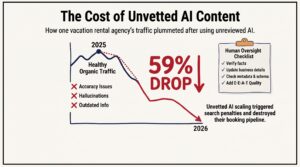
Consider a boutique vacation rental agency in a popular coastal destination. To build out local travel guides and landing pages faster, they used AI tools to quickly scale their blog content. The pages went live with minimal human review, lacking localized details or firsthand insights.
At first, indexation was rapid. But as search engines rolled out updates targeting scaled content, the consequences were severe: in 2026, their organic traffic is down 59% compared to the same period in 2025. The drop directly impacted their direct booking pipeline and revenue.

What to Do If Your Site Suffers an “AI Content” Traffic Drop
Prune unhelpful or generic AI pages: Identify thin, low-traffic pages created primarily with raw AI output. Consolidate them into comprehensive resources or remove them completely.
If your site experienced a similar drop in organic visibility after publishing AI-assisted copy, take these steps to audit and recover your search standing:
- Audit for accuracy and hallucinations: Cross-reference local information, property details, pricing and amenities against primary source data.
- Inject unique value: Add original photography, custom FAQs based on real guest inquiries and firsthand recommendations from local experts.
- Resubmit high-value pages for re-indexing: Once audited and enhanced, request re-indexing in Google Search Console to signal structural updates.
AI Is a Drafting Tool, Not a Publisher
AI works best in the early stages of digital marketing content creation. Use it for outlining, drafting initial concepts, repurposing existing information, generating title variations and spotting content gaps.
Your job is to infuse the content with Google’s E-E-A-T signals (Experience, Expertise, Authoritativeness and Trustworthiness) – the elements AI simply cannot reliably provide:
- Verified facts: Accurate statistics, dates, regulatory details and quotes.
- Firsthand experience: Subject-matter expertise, real-world examples and case studies.
- Accurate business details: Correct pricing, company policies and service areas.
- Original insight: Unique perspectives, local context and brand commentary.
- Authentic voice: A natural, credible tone that aligns with your brand identity.
- Final editorial approval: Human accountability before publication.
Google’s main concern is intent. Content created primarily to manipulate search rankings creates search engine pollution. Helpful, original content designed for humans builds long-term authority. Use AI to support the second kind, not to churn out generic filler pages.


Don’t Forget the “Invisible” Content
Many teams review the visible page copy and stop there. That’s a mistake.
An AI tool might draft a strong blog post, but then generate:
- A page title that overstates the article’s actual content.
- A meta description that promises information you don’t actually include.
- Structured data (schema) with an incorrect business name, date or rating.
Small errors in your website metadata and code can distort how search engines understand and display your pages.
Local Search Requires a Complete Strategy
Run every AI-assisted page through these 7 checks before publishing:
1. Verify every claim and source
- AI frequently pairs real primary sources with false conclusions.
- Double-check names, dates, pricing, regulations and statistics against primary sources.
- Open cited links to confirm the source actually supports the specific claim being made.
- If a claim cannot be verified independently, treat it as unconfirmed and remove it.
2. Confirm business-critical details
Errors here directly impact customers and revenue. Verify:
- Business name, address and contact details
- Active services and exact service areas
- Operating hours and availability
- Pricing models and financing terms
- Credentials, licenses and certifications
- Legal, medical, financial or safety claims
3. Cut unsupported superlatives and misleading framing
Words like “best,” “leading,” “trusted,” “award-winning” or “most affordable” should remain only if backed by verifiable proof. Otherwise, swap them for specific value propositions. Watch for content that is technically true but omits key limitations, presents opinion as fact or promises guaranteed outcomes.
4. Review titles and meta descriptions
Ensure page titles accurately reflect the content and meta descriptions match what visitors will find. Avoid clickbait, unsupported promises and duplicate descriptions across pages.
5. Validate structured data and alt text
If AI generated your schema markup, inspect every field: entity names, dates, ratings, prices and addresses. Validate structured data using Google’s official testing tools to confirm eligibility for rich search results. For image alt text, ensure it concisely describes what is actually shown rather than stuffing keywords.
6. Add what generic AI answers omit
Ask yourself: What does this page offer that a standard ChatGPT response couldn’t? Inject real customer questions, process breakdowns, original photos, local insights or expert quotes.
7. Read it aloud
A final human read-through catches awkward phrasing, repetition, passive tone and anything that fails to sound like your brand.


A Practical AI Approval Workflow
To maintain speed without sacrificing quality, establish a clear review pipeline:
[1] AI Drafts ➔ [2] Subject Matter Expert ➔ [3] Editor ➔ [4] SEO Reviewer ➔ [5] Final Sign-off
1. AI Generation: Drafts the initial outline and structure.
2. Subject-Matter Expert (SME): Verifies factual accuracy, technical terminology and business specifics.
3. Editor: Refines clarity, brand voice, sentence structure and originality.
4. SEO Reviewer: Checks titles, meta descriptions, internal links, headings, and schema validation.
5. Final Approver: Signs off for publication.
The Bottom Line
Google isn’t telling you to stop using AI. It’s telling you to stop publishing AI website content without oversight.
Use AI to move faster, but keep a human accountable for accuracy, trust and brand safety. In the age of AI search, the businesses that win won’t be those publishing the most pages. They’ll be the ones publishing the most reliable ones.


Categories
- AI Optimization
- Compliance
- Digital Marketing
- Email Spam
- Home Elevator Digital Marketing
- Home Elevators
- Home Generators
- Home Genrator Dealer Marketing
- Local Search
- Pest Control
- Pest Control Consumer Trends
- Pest Control Digital Agency
- Pest Control Marketing
- PPC
- Pressure Washing
- Pressure Washing Consumer Trends
- Pressure Washing Digital Agency
- Pressure Washing Marketing
- ROAR! Internet Marketing
- SEO
- Social Media
- Vein Clinic
- Vein Clinic Digital Marketing
- Web Design